Follow the yellow brick road
The idea of a super-app which on a single platform can deliver unprecedented convenience and personalization through search, messaging, media, video chats, payments, ride hailing, travel, and food delivery is hugely appealing.
Elon Musk’s acquisition of Twitter has spurred considerable online debate about whether he has plans to transform Twitter from a would-be platform for free speech to something much more powerful – a super app to rival the footprint and success of WeChat in China.
Is it possible to deliver a globally dominant super app via Twitter? Possibly? We are talking about a visionary who doesn’t easily take no for an answer. We know Elon’s early career was in payments and he’s already signaled his ambitions to add financial and payments capabilities to Twitter, which would be a first step to an app with more functionality.
That said here’s a few of the challenges that Twitter would need to overcome to become a universally dominant super-app, assuming Twitter survives the current restructuring that is afoot:
Growing the subscriber base
At present Twitter has around 237 million monetizable daily active users, which is significant in absolute terms, but pales in comparison to the ecosystems that other platforms host. According to a recent article by @GrousARK WeChat has scaled to a billion users.
Finding a sustainable revenue model
The way digital platforms make money is changing, quite rapidly and Twitter is at the midpoint of that evolution. It’s hard to imagine how a company can get to be this influential without such a model. In the first quarter of 2022 Twitter reported an operating loss of $128 million.
Compliance
Complying with a vast array of competition, consumer protection, anti-money laundering and data privacy laws across different jurisdictions. The move to add functionality will bring greater regulatory compliance. Regulators in high income markets with stronger competition and consumer protection remits might be less supportive of super-app ambitions than their peers in emerging and developing markets.
Overcoming regional dominance
Elon will need to address the dominance of existing social media platforms and the ‘stickiness’ of its users across different regions. It doesn’t matter whether we are talking about social media platforms or drycleaning services, consumers often have a preference to use what they know.
Regional interpretations
Grappling with different regional interpretations on what constitutes free speech may not be straightforward. What is considered free speech in one jurisdiction could be regarded as sedition in another. A super-app could become a powerful weapon for an authoritarian regime.
Building consumer trust
There is already ample disquiet about the ability of big tech platforms to engineer and control consumer behaviour, so how will consumers feel about a super-app that aggregates our interactions on a single platform?
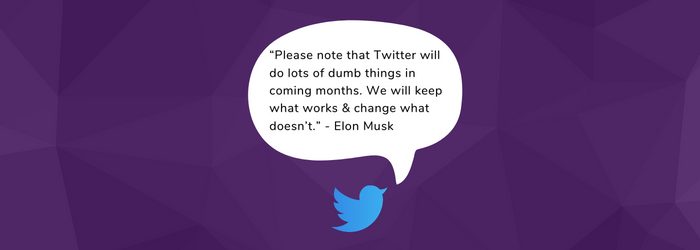
“Please note that Twitter will do lots of dumb things in coming months. We will keep what works & change what doesn’t.”– Elon Musk
Elon has already tweeted a warning to us all – “please note that Twitter will do lots of dumb things in coming months. We will keep what works & change what doesn’t”. So, who really knows where the super-app ambitions end up? Do we end up with ‘everything X’ or something less than that? As mentioned earlier there’s at least some possibility Twitter doesn’t survive beyond Elon’s current restructuring . And what impact does that have on SpaceX and Tesla? It’s not like the Chief Twit doesn’t already have a day job.
Elon Musk is the sort of leader that starts with a big picture vision of what the future could look like and then progressively works towards that, dealing with the challenges as they arise. He’s certainly a polarizing figure who’s not afraid to make big calls. Whether you love or loathe Elon, it is worth considering whether there are any big calls you need to make to transform your business. Which of those big challenges would you address first?